X spoke, ‘Trane played - A Conversation with Richard Brent Turner
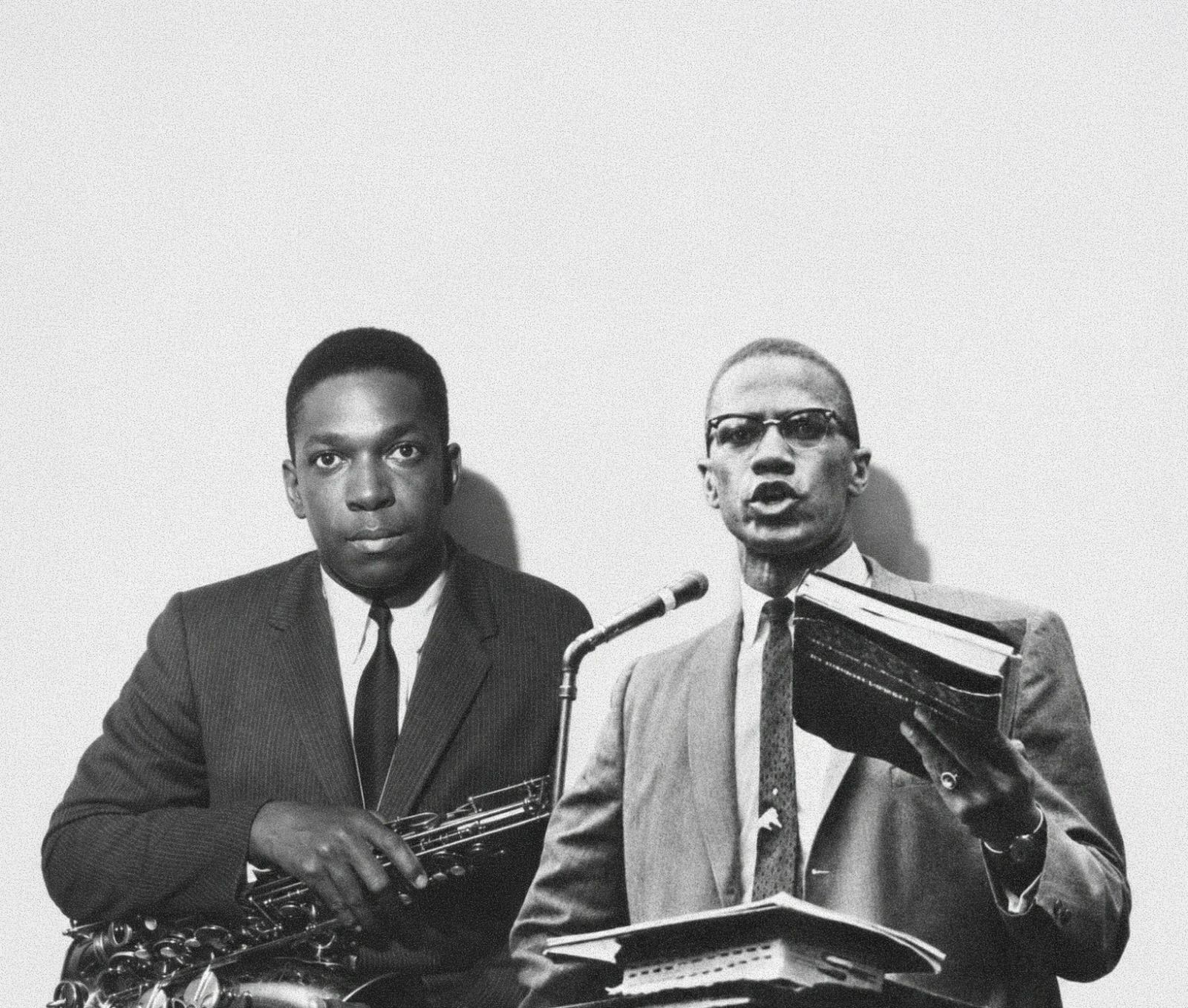
And I believe essentially what Malcolm said is what John played.
- Archie Shepp (quoted in Soundtrack for a Movement).
In his 2024 Gifford Lectures, Cornel West draws into contrast Coltrane’s Alabama, Dr. King’s Birmingham eulogy, and Strauss’ Capriccio. He asks, “What is greatest? Poetry or instrumental music? Maybe it's the human voice itself. Just like the Church of Christ. No instruments, its acapella. Unmediated by all the accompaniments that the instruments provide.” This brings to mind a November 1966 concert. During a performance at Temple University, John Coltrane placed his saxophone on the ground. What came next no one expected. Maybe the audience should have. He began thumping his chest. His instrument or voice couldn’t relay what his soul needed out; ‘Trane knew his being was at stake. There was something greater than both human voice and instrument. When words and instruments failed, the only thing left is to beat your chest.
Coltrane wasn’t alone in understanding the spiritual stakes of jazz. In Soundtrack to a Movement - African American Islam, Jazz, and Black Internationalism, Richard Brent Turner brilliantly chronicles the “golden ages” of African-American Islam and jazz. He details their mid-20th century overlap, shared commitments to black liberation, mutual solidarity with anti-colonial resistance, and joint contribution to “a new diasporic Afro-American identity.” Nonetheless, jazz and African-American Islam in mid-century America were more than overlapping. In the words of Muslim jazz drummist Art Blakey (quote taken from Soundtrack): “Islam brought the black man what he was looking for, an escape like some found in drugs or drinking: a way of living and thinking he could choose in complete freedom…It was for us, above all, a way of rebelling.”
Turner presents “John Coltrane and Malcolm X [as] jazz brothers in rhythm and spirit.” They were also revolutionaries committed with their lives and being to Truth and freedom. Perhaps Miles Davis said it best (quote taken from Soundtrack), “Trane’s music….represented for many Blacks, the fire and passion and rage and rebellion and love they felt, especially among the young Black intellectuals and revolutionaries of that time…He was their torchbearer in jazz.” Both John and Malcolm knew times call for beating their chests.
—
lindy hop|improv|x
Malcolm was a lindy hop dance star at the Savoy Ballroom in Harlem, one of the great places for the performance of jazz in the 1940s and 50s. He was dancing before Dizzy, before Duke Ellington's band. He also was a lindy hop star in Boston. [Jazz] was a major part of his life before he got incarcerated.
Malcolm’s friend [Malcolm Shorty Jarvis] was a professional jazz saxophonist. They converted to Islam together in Massachusetts prisons in the 1940s. Jazz is a constant theme in [Malcolm’s] life. When he began traveling in 1964 to various African countries that had released themselves from colonialism, he was tapping into African-American jazz fans in these various countries, from Ghana to Kenya to Egypt. [Malcolm] was fascinated by the ways African-American jazz fans, many of them black expatriates from the US, were connecting jazz to a kind of anti-colonial musical culture that also incorporated African indigenous elements. Jazz was a central theme throughout Malcolm X's life. Even when he converted to the Nation of Islam and then to Sunni Islam, he had a great love for [the music.]
Improvisation was a major theme throughout [Malcolm’s] entire life, from his [lindy hop] dancing in those great jazz ballrooms…to his conversion away from the Baptist religion…Improvisation, making changes in his life that are creative and experimental, had a lot to do with his conversion to Sunni Islam in 1964, when he officially left the Nation of Islam and made the Hajj and then started traveling internationally to Africa and the Middle East.
‘trane|cookies|dhikr
John Coltrane’s first wife was Naima. She was a practicing Muslim. Coltrane was living in a Muslim household, and his step-daughter Seda, was also Muslim. It was Naima that [helped] him kick his drug addiction cold turkey. According to Yusef Lateef, Naima had a very strong influence on John Coltrane’s spirituality and the direction that his music was going in Philadelphia. When living in Philadelphia in the 1940s and 50s, Coletrane was surrounded by a circle of African-American Muslims. This included McCoy Tyner and his wife. Tyner had converted to the Ahmadiyya Muslim community early on in his life. Coltrane [said] he had thought about converting to Islam, but he just never got around to it.
Coltrane brought so many different talented Muslim musicians into his band. Pharaoh Sanders [was] one of them. I see Coltrane as an interfaith mystical musician. He's looking at varieties of religious traditions through his music; he's open to the spirituality from varieties of important religious traditions that he can translate into his music. Of course, John Coltrane was born into a very strong African Methodist Episcopal family in North Carolina. So, you know, at heart he was a black Protestant guy, but Islam was a constant.
“Love supreme,” I basically found, [is] an Islamic prayer. [Coltrane’s] chanting with his musicians, and you very rarely hear [his] voice. [S]ome scholars think that he's saying “Allah Supreme Allah Supreme Allah Supreme.” Yusef Lateef had so much to say about A Love Supreme. He [was] very close friends with John Coltrane and a practicing Muslim. Lateef said at the very end of Coletrane’s life, I guess Coletrane didn't know he was going to die suddenly from cancer; he had hooked [him] up with his realtor. Coltrane was going to create a place somewhere in the New York City area where people could listen to jazz without liquor, without alcohol, and even children could listen to jazz. There would be cookies and milk and things like that served. Lateef and Coltrane had [also] made a commitment to travel to West Africa together. They had made a plan to have concerts in New York City together, but it all never came to fruition because ‘Trane passed away very suddenly.
conversion|knocking|black arts
If Coltrane had officially converted to Islam, there would have been a big article in Life magazine and Ebony magazine. It would have been noted by the mainstream media. I found [it] fascinating reading Alice Coltrane’s interviews, and she was not a Muslim, that Coltrane, when in New York City, was attending Malcolm X's lectures and speeches every chance he got. He deeply admired Malcolm X and what Malcolm X was saying in the last year of his life. Given the tenor of the conversion experiences of jazz musicians, African-American jazz musicians at that time, [Coltrane] probably would have converted.
Malcolm X was converting jazz and rhythm &blues musicians like Etta James. They were living in the Teresa Hotel. Malcolm X was, you know, knocking on [James’] door; she had been sleeping late because she was performing, and he had encouraged [her] to convert to the Nation of Islam. And, in fact, she did that. Her name was Jameseta X. Malcolm understood the mentality, spirituality, potential spirituality of jazz musicians. He used that to convert people who had been deeply involved in jazz culture, whether they were musicians, fans, or Lindy Hop dancers. There's a lot of improvisation there.
Archie Shepp’s observation comes at the beginning of the Black Arts Movement. Amiri Baraka starts the Black Arts Movement with jazz musicians, and this includes John Coltrane. A few days after Malcolm X dies, [Coltrane, Shepp, Sun Ra, and others] came together for concerts to honor Malcolm X and create[d] an album. I see Archie Shepp as part of the beginning of the Black Arts Movement, where jazz musicians had a great role to play in honoring Malcolm X. And of course, the black arts movement expands with poetry, with books, autobiographies, fictional books. It became a huge movement.
stokley| expats| internationalism
[Stokley Carmichael in Greenwood, MS] certainly is a major landmark for the public notice of the Black Power movement. You also have to look at all of those black expatriates before 1965, like Maya Angelou, who decided to leave the United States and [join] President Kwame Nkrumah. Ghana was the first West African nation to release itself from colonialism. That was a great attraction to a lot of black artists, educators, and business people. DuBois and his wife landed there in 1961. They were facing persecution from the US government. Their passports had been withheld for a number of years.
There's a lot more to the black power movement that predates 1966. But of course Stokely Carmichael sent Black Power in a public space. He was the chairperson of the Student Nonviolent Coordinating Committee (SNCC) and a protégé of Martin Luther King Jr. That really put Black Power on the map of all public media, but things have been going on much earlier.
Jazz musicians like Randy Weston, the great pianist, [came] out of a Black Power environment. His father in Brooklyn was a member of Marcus Garvey's Universal Negro Improvement Association (UNIA-ACL). There is Ahmed Abdul Malik, a talented jazz [bassist]. In the 1940s, he was in Bedford-Stuyvesant along with Randy Weston, and he converted to the Ahmadiyya Muslim community. [Malik’s] speaking Arabic, playing with Middle Eastern instruments like the qanun and oud. He's interacting with Arab musicians on Atlantic Avenue in Brooklyn. There are all of these musicians who are part of the Black Power movement in different ways, but we're not thinking about them the way that we think about Stokely Carmichael. Kenny Clark, a great jazz drummer, in the 1950s decides to leave the United States and move his family to Paris to escape racism in the musical world and life during the Jim Crow era.
All of that is motivated by an understanding of black internationalism, which may hold out a better way of life, especially if you're going to move out of the United States with your family. We also have to emphasize that Malcolm X grew up in a black internationalist family. His father was murdered, most likely [for] preaching black internationalism through Marcus Garvey’s Universal Negro Improvement Association. His mother was translating the Negro World newspaper into French. [Malcolm] grew up in a family that was very sophisticated, politically, in terms of black internationalism in the 1920s and the 1930s. Of course, they paid a horrific price for being missionaries for the Marcus Garvey movement in the Midwest.
revolution|corners|roxbury
[Rebellion, resistance, and revolution] were interconnected. Even Martin Luther King Jr. [called] what's happening in the civil rights movement in the 1960s a part of [a] black revolution. You know, it is this idea of resistance to the Jim Crow era and to anti-Black racism, rebellion against that, and all of this is a part of a black revolution in America that takes many different forms and involves many different religious traditions all at the same time.
I grew up in one of those communities in Boston, in Roxbury, Massachusetts. Malcolm X actually lived in my neighborhood in the 1940s. I could take a 10-minute walk from my house to the house that [Malcolm] grew up in as a teenager.
We [saw] all of these different strands of black revolution on our street corners. Of course, we had civil rights activism going on in black churches. And also we [had] the Nation of Islam representatives every day of the week selling newspapers on a specific street corner in Roxbury. You would go into your corner store in Roxbury in the 1960s and 1970s, and there were the Nation of Islam newspapers. When Imam Warith [Deen] Muhammad [moved] the Nation of Islam to Sunni Islam, you could buy [his literature] in corner stores where you could go get your candy or your posters or your mainstream newspapers. All these different strands of rebellion, resistance were a part of a black revolution that was going on in America in the 1960s, even into the 1970s. It was evident in many different African-American communities on the streets.
listenings|playlists
“Strange Fruit” (Billie Holiday)
Live at Birdland (John Coltrane)
A Love Supreme (John Coltrane)
Offering: Live at Temple University (John Coltrane)
We Insist! - Max Roach’s Freedom Now Suite (Max Roach, Abby Lincoln)
The Creator Has a Masterplan (Pharoah Sanders)
Live at Per’s (Yusef Lateef)
Moanin’ (Art Blakey and the Jazz Messengers)
Enlightenment (McCoy Tyner)
Universal Consciousness (Alice Coltrane)
Dr. Richard Brent Turner is a Professor at the University of Iowa, with appointments in Religious Studies and African American Studies. His research focuses on African-American religious history and African diaspora religions, particularly Islam in the United States, religion and music, and the Black Atlantic. He is the author of 'Soundtrack to a Movement: African American Islam, Jazz, and Black Internationalism' (NYU Press, 2021).